
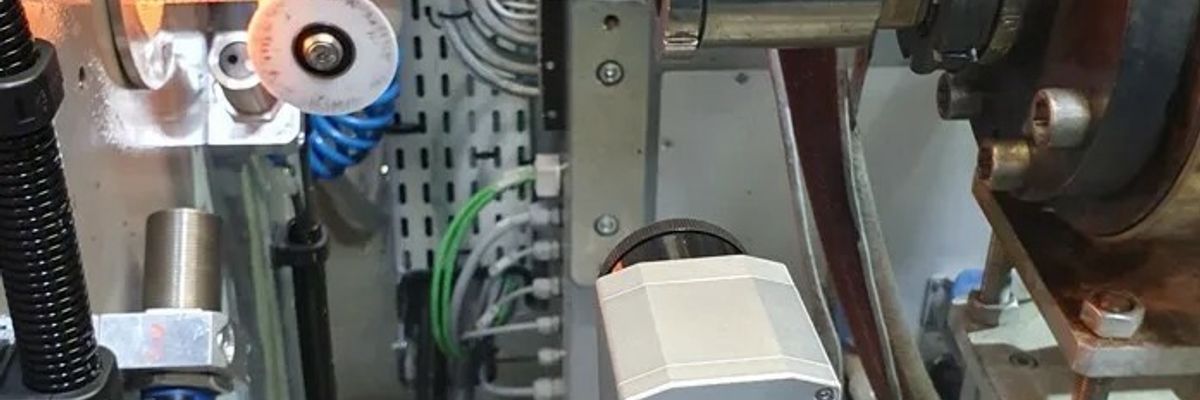
Challenges in Hose Production
In garden hose manufacturing, maintaining precise surface temperature is critical for ensuring strong and reliable bonding between layers. The production process operates at high speed, with hoses continuously moving through multiple heating and cooling stages.
Temperature fluctuations during these stages can lead to weak adhesion between layers or material degradation. If the temperature is too low, the layers fail to bond properly, compromising the hose’s strength. If it is too high, the material may lose its physical properties and structural integrity.
Additional challenges arise from high ambient temperatures and the rapid movement of the hose, making it difficult for traditional point-based sensors to provide accurate and complete measurements across the entire surface.
Understanding Hose Structure and Thermal Requirements
A garden hose consists of multiple layers, each serving a specific function. The inner layer, typically made of PVC or rubber, ensures smooth water flow and flexibility. The reinforcement layer, composed of textile fibers such as polyester or nylon, provides strength and pressure resistance. The outer layer protects the hose from environmental and mechanical damage.
Temperature plays a crucial role in bonding these layers together. Proper heat ensures fusion and adhesion, while incorrect temperature conditions can result in weak bonding or structural defects.
During production, hoses are exposed to temperatures reaching up to 200°C, followed by cooling phases. These repeated thermal cycles require precise monitoring to maintain consistent product quality.
Infrared Temperature Monitoring for Full-Surface Control
Infrared cameras provide an effective solution for real-time, full-surface temperature monitoring in hose production. Unlike traditional pyrometers that measure temperature at a single point, infrared cameras capture thermal data across the entire hose surface.
Installed at a safe distance from the production line, these cameras continuously monitor temperature variations at high speed. This allows manufacturers to detect even minor deviations instantly and ensure uniform heat distribution across the product.
Real-time thermal imaging enables operators to maintain optimal temperature conditions, ensuring consistent bonding and preventing defects before they occur.
Automated Process Control with Thermal Imaging
By integrating infrared cameras into the production system, manufacturers can achieve automated temperature control. Thermal data is processed in real time, allowing the system to trigger alarms or automatically adjust heating elements when deviations are detected.
Software solutions such as PIX Connect enable detailed analysis by dividing the hose surface into multiple measurement zones. This ensures accurate monitoring across different areas, even when thickness variations affect temperature distribution.
Integration with PLC systems allows seamless communication between temperature monitoring and process control, ensuring immediate corrective actions and stable production conditions.
Advantages Over Point-Based Measurement Systems
Traditional pyrometers are limited to single-point measurements, which makes it difficult to detect localized temperature variations across a fast-moving product. This limitation often leads to undetected defects and increased material waste.
Infrared cameras, on the other hand, provide full-field thermal imaging, ensuring comprehensive monitoring of the entire hose surface. High frame rates allow accurate measurement even at high production speeds, while high thermal sensitivity enables detection of even the smallest temperature differences.
Additionally, robust camera designs and protective accessories allow reliable operation in harsh industrial environments with high ambient temperatures and contaminants.
Improving Efficiency, Quality, and Reliability
The implementation of infrared temperature monitoring in hose production delivers significant benefits
Ensures consistent layer bonding through precise temperature control
Reduces scrap rates by detecting thermal inconsistencies early
Supports fully automated process control and faster response to deviations
Improves overall product quality and structural integrity
Minimizes downtime caused by manual inspections and defective batches
By enabling continuous monitoring and immediate corrective actions, manufacturers can achieve more stable and efficient production processes.
Precise temperature control is essential for ensuring quality and reliability in hose production. Traditional measurement methods are no longer sufficient for high-speed, multi-layer manufacturing processes.
Infrared temperature monitoring provides a comprehensive and non-contact solution for tracking thermal conditions in real time. By capturing full-surface temperature data and enabling automated control, it significantly improves product quality, reduces waste, and enhances production efficiency.
As manufacturing processes continue to evolve, integrating advanced thermal imaging technologies will be key to achieving consistent, high-quality results in hose production.


