
Challenges in Large-Scale Fever Screening
In post-pandemic environments public health safety requires fast reliable and hygienic fever screening methods Traditional contact thermometers are not suitable for high traffic areas such as airports offices schools and public venues
These devices are slow require physical interaction and create a risk of cross contamination when used repeatedly across large groups of people This makes them impractical for large scale screening where speed and safety are critical
Additionally screening systems must operate without disrupting the natural flow of people while still providing accurate results under varying environmental conditions
These challenges highlight the need for a non contact solution capable of delivering rapid and reliable temperature measurements in real time
Importance of Infrared Thermography in Public Health
Infrared thermography provides an effective non invasive method for detecting elevated body temperatures without physical contact
By capturing infrared radiation emitted from the human body thermal cameras can determine surface temperature instantly This allows for fast screening of large numbers of individuals while minimizing infection risks
This technology has become especially important following global outbreaks such as COVID 19 Ebola and swine influenza where early detection of fever plays a critical role in preventing the spread of disease
Infrared screening systems enable organizations to maintain safe environments while ensuring continuous operation of public spaces
Accurate Fever Detection through Facial Temperature Analysis
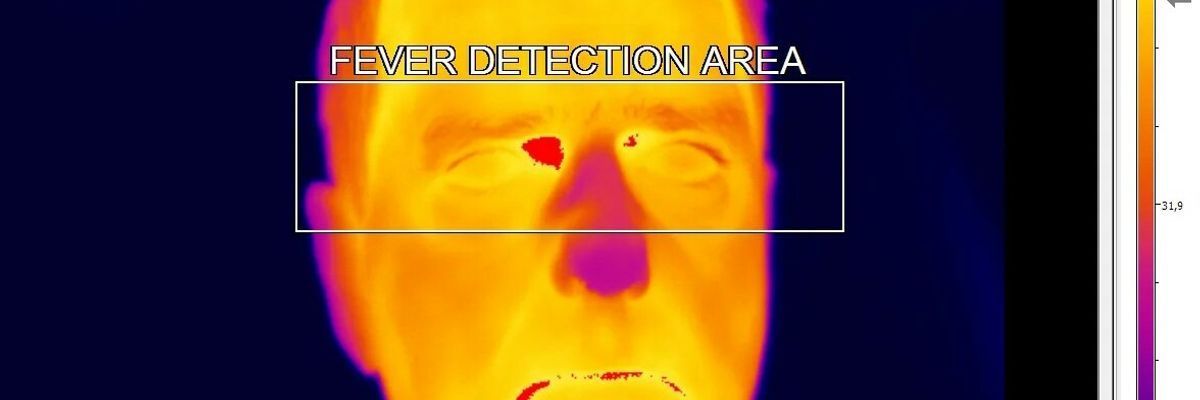
The most reliable external temperature measurement is obtained from the medial canthus area near the tear duct This region closely reflects core body temperature compared to other areas of the face
Infrared cameras detect temperature differences across the face and identify individuals whose readings exceed the normal range under similar ambient conditions
This targeted approach significantly improves screening accuracy compared to general surface temperature measurement
Advanced Monitoring with Optris PI and Xi Infrared Cameras
The Optris PI and Optris Xi infrared cameras provide high precision thermal imaging designed for fever screening applications
These cameras operate within a temperature range of minus 20 to 100 °C and are capable of detecting extremely small temperature differences down to 0.04 °C This sensitivity allows reliable identification of individuals with elevated body temperature
Their high resolution thermal imaging ensures accurate detection even in crowded environments where multiple individuals are screened simultaneously
The cameras are compact easy to install and suitable for both fixed and portable setups making them adaptable to different screening locations
Enhanced Accuracy with BR 20AR Reference Source
To achieve high measurement accuracy the system integrates the Optris BR 20AR ambient reference source
This black body reference provides a stable temperature point with an accuracy of plus minus 0.1 °C allowing calibration of the infrared camera in real time
By combining the camera with this reference source the overall system accuracy can be improved to approximately plus minus 0.5 °C ensuring reliable and consistent results
This calibration compensates for environmental factors such as ambient temperature changes and device drift
Real Time Monitoring and Alerts with PIX Connect Software
The system is supported by PIX Connect software which enables real time analysis monitoring and alert generation
The software highlights areas where temperature exceeds predefined thresholds allowing operators to quickly identify individuals with potential fever
Automatic alarms can be triggered when abnormal temperatures are detected enabling immediate response
The system can also capture and store thermal images for documentation ensuring traceability and compliance with health regulations
Flexible Deployment and Integration
Infrared fever screening systems are designed for easy installation and relocation allowing rapid deployment in various environments
They can be integrated into existing security and access control systems providing automated monitoring and response
User friendly interfaces and customizable alarm settings ensure that the system can be adapted to specific operational needs
This flexibility makes infrared screening suitable for workplaces transportation hubs healthcare facilities and public venues
Improving Public Safety and Operational Efficiency
Non contact fever screening enhances public safety by reducing the risk of infection transmission during temperature checks
It allows organizations to screen large numbers of people quickly without causing delays or crowding
Accurate temperature detection helps identify potentially infected individuals early enabling preventive measures to be taken
At the same time automation and real time monitoring improve operational efficiency and reduce the need for manual intervention
Non contact infrared fever screening is a key component of modern public health strategies in post pandemic environments
By providing fast accurate and hygienic temperature measurement it helps prevent the spread of infectious diseases while maintaining smooth operation of public spaces
With advanced technologies such as Optris PI and Xi infrared cameras combined with BR 20AR reference sources and PIX Connect software organizations can achieve reliable screening high accuracy and efficient process control
The integration of infrared thermography into public health systems ensures safer environments improved monitoring and long term readiness for future health challenges


