
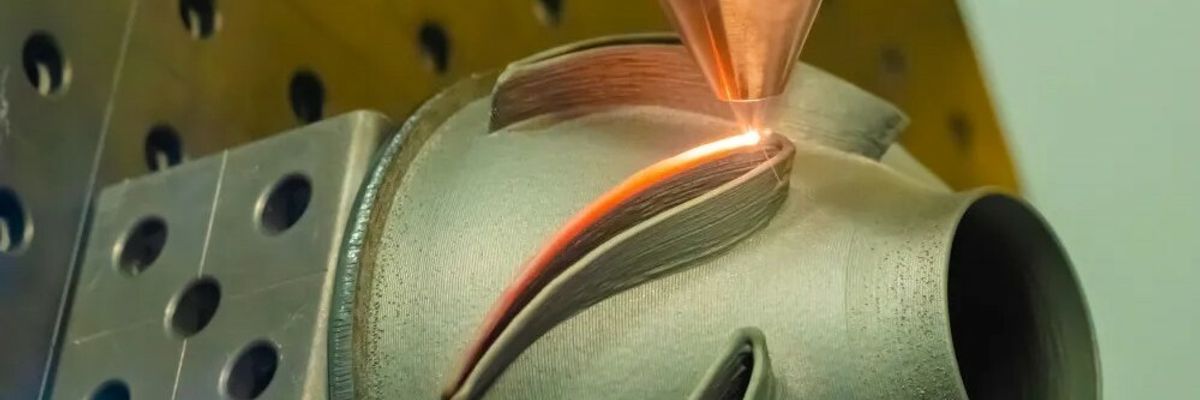
Challenges in Laser Metal Deposition
Laser Metal Deposition (LMD) is a highly advanced additive manufacturing process used to produce and repair complex metal components. However, achieving consistent quality remains challenging due to the process’s extreme and rapidly changing thermal conditions.
Fluctuations in temperature can lead to defects such as porosity, cracking, and geometric distortion. These issues directly affect the mechanical properties and structural integrity of the final component.
Additionally, the presence of high-energy laser radiation and reflections makes accurate temperature measurement difficult. Complex geometries and dynamic melt pool behavior further complicate process monitoring, increasing the risk of defects and inconsistencies.
Understanding the LMD Process and Thermal Behavior
In Laser Metal Deposition, a high-energy laser creates a molten pool on a metal substrate while metal powder is continuously fed into it through a nozzle. The material solidifies layer by layer, forming the final structure.
This process is widely used not only for additive manufacturing but also for repair and coating applications due to its flexibility and precision. Typically, solid-state lasers operating at 1064 nm or CO₂ lasers at 10.6 μm are used.
The thermal behavior of the melt pool plays a critical role in determining the final material properties. Rapid heating and cooling, combined with localized heat input, create steep temperature gradients that can result in residual stresses and microstructural inconsistencies.
Without proper control, these thermal effects lead to defects such as pores, cracks, and uneven material distribution, reducing component reliability.
Infrared Temperature Monitoring for Process Control
Real-time infrared temperature monitoring provides an effective solution for controlling the LMD process. By using thermal imaging, operators can observe temperature distribution and melt pool dynamics without interfering with the process.
Infrared cameras enable continuous monitoring, allowing early detection of thermal irregularities. This makes it possible to adjust process parameters such as laser power, scanning speed, and material feed rate in real time.
Maintaining optimal temperature conditions ensures stable melt pool behavior, consistent layer bonding, and improved material properties throughout the build.
Accurate Measurement in High-Energy Laser Environments
LMD processes operate under intense laser radiation, which can interfere with temperature measurement and damage sensors. Reliable monitoring requires specialized infrared systems capable of operating in these harsh conditions.
Two key approaches are used to ensure measurement accuracy
Using infrared cameras that operate outside the laser wavelength range
Applying protective filters to block laser radiation
Solutions such as notch filters and long-pass filters protect infrared cameras from high-energy laser interference. This enables accurate temperature measurement even in environments with strong reflections and high energy density.
Infrared imagers such as the Optris PI 08M provide detailed visualization of heat distribution across the process area. Unlike single-point pyrometers, these cameras capture full-field thermal data, offering deeper insights into process behavior.
Optimizing Metal Temperature Measurement
Accurate temperature measurement in LMD requires careful consideration of emissivity, which varies depending on material type, surface condition, temperature, and wavelength.
Metal surfaces present particular challenges, as their emissivity changes dynamically during the process. For this reason, short-wave infrared measurement is typically preferred. At shorter wavelengths and higher temperatures, metals exhibit higher and more stable emissivity, reducing measurement errors.
However, since laser absorption equals emissivity, the interaction between the laser and the material must be considered. To prevent interference and ensure safe operation, notch filters are used to block laser radiation and eliminate crosstalk.
Process Optimization Through Real-Time Thermal Data
Integrating infrared thermography into LMD systems enables continuous monitoring of the process’s thermal profile. This data provides valuable insights into heat distribution, cooling rates, and thermal gradients.
By analyzing this information, manufacturers can optimize process parameters and improve process stability. Real-time feedback allows for immediate correction of deviations, reducing the likelihood of defects and improving overall production efficiency.
Thermal monitoring also supports the development of closed-loop control systems, enabling automated adjustments and further enhancing process reliability.
Enhancing Quality, Reliability, and Efficiency
The implementation of infrared temperature monitoring in Laser Metal Deposition delivers several key benefits
Early detection of defects such as porosity and cracking
Improved control over melt pool behavior and heat input
Reduction of residual stresses and geometric distortions
Enhanced process consistency and repeatability
Increased structural integrity and reliability of components
By combining precise temperature measurement with advanced thermal imaging, manufacturers can significantly improve both product quality and production efficiency.
Laser Metal Deposition offers significant advantages for metal additive manufacturing, but its success depends on precise thermal control.
Infrared temperature monitoring provides a powerful tool for managing the complex thermal dynamics of the process. It enables real-time detection of irregularities, supports process optimization, and ensures consistent, high-quality results.
As LMD technology continues to evolve, the integration of advanced infrared monitoring systems will play a crucial role in reducing defects, improving reliability, and enabling the production of high-performance metal components.


