
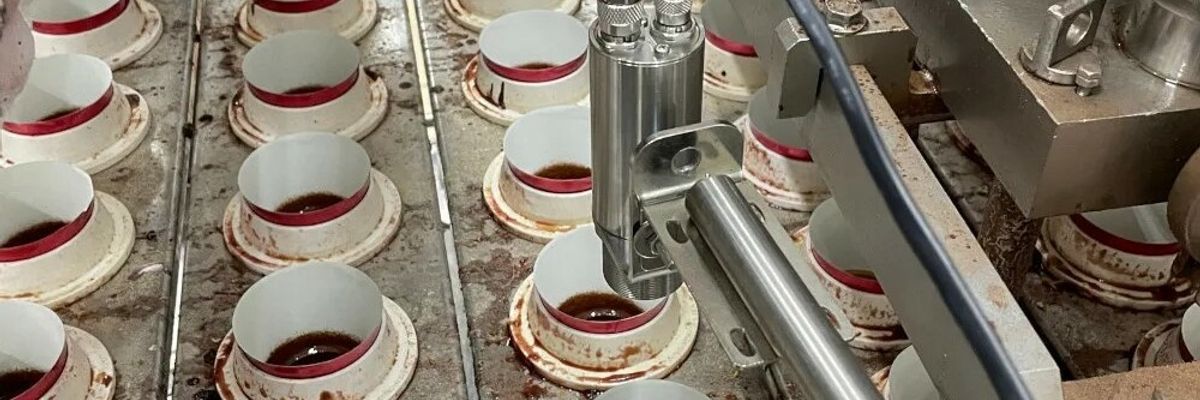
In modern food manufacturing, maintaining consistent product quality while minimizing waste is a constant challenge. This is especially true in high-speed, automated environments such as ice cream cone production, where even minor inconsistencies can lead to significant losses. One of the most critical stages in this process is chocolate spraying, where precision and uniformity directly impact both product appearance and taste.
Challenge in Chocolate Coating Consistency
Inconsistent chocolate spraying during cone production can result in uneven coating, leading to product rejects and unnecessary waste. Common issues such as blocked nozzles, incorrect spray pressure, or temperature fluctuations often go undetected in real time. As a result, defective cones continue along the production line, compromising overall quality and increasing operational costs.
Given the speed of production—up to one cone every 1.5 seconds—even a small defect rate can escalate quickly. For example, a 1% failure rate can result in hundreds of rejected products daily, creating both financial and sustainability concerns.
Automated Production and Quality Control Needs
Ice cream cone production is a fully automated process involving multiple stages, including mixing, freezing, molding, topping, and packaging. Each stage must operate seamlessly to ensure consistent output. During the chocolate coating phase, liquid chocolate is applied to cones, but variations in temperature, pressure, or equipment performance can lead to defects.
Without effective monitoring, these issues can persist unnoticed, resulting in high reject rates. Therefore, automated quality control systems are essential to detect deviations immediately and ensure that only products meeting quality standards proceed further.
Infrared Technology as a Solution
To address these challenges, manufacturers are increasingly turning to infrared (IR) thermal imaging technology. A key solution involves the use of the Optris Xi 400 infrared camera integrated with DewesoftX software. This system enables real-time monitoring of the chocolate spraying process by analyzing temperature distribution across the cones.
The Optris Xi 400 is a compact and robust thermal imaging camera with a resolution of 302 × 288 pixels. It combines the durability of a pyrometer with the advanced capabilities of an infrared camera, making it ideal for industrial environments. The camera is mounted above the production line and positioned to capture both the edges and inner surfaces of the cones.
Real-Time Monitoring and Defect Detection
The system continuously records temperature data, including average, maximum, and minimum values. By comparing these parameters, it can identify irregularities in the chocolate coating. For instance, if the maximum temperature is too low or the minimum temperature too high, it may indicate uneven spraying or nozzle malfunction.
This real-time analysis allows the system to detect non-conforming products instantly. Once identified, defective cones are automatically removed from the production line, ensuring that only high-quality products reach the final stages.
Integration with DewesoftX Software
The DewesoftX software plays a crucial role in this solution by providing advanced data visualization, analysis, and storage capabilities. Through the Optris plugin, the software seamlessly integrates with multiple camera models, including the Xi 400, PI 400i, and PI 640i.
This integration enables continuous monitoring, precise temperature control, and immediate response to anomalies. It also supports predictive maintenance by identifying early signs of equipment malfunction, reducing downtime and maintenance costs.
Benefits of IR-Based Quality Monitoring
The implementation of infrared technology in ice cream cone production offers several key advantages. It significantly reduces waste by identifying and removing defective products in real time. It ensures consistent chocolate coverage, improving both the visual appeal and taste of the final product.
Additionally, the system enhances production efficiency through continuous and reliable monitoring. Its seamless integration into existing production lines supports full automation without requiring major modifications. Early detection of spray system issues also minimizes downtime and maintenance efforts.
Enhancing Efficiency and Sustainability
For large-scale manufacturers operating across multiple countries, maintaining consistent quality while optimizing efficiency is critical. Infrared thermal imaging provides a powerful tool to achieve both goals. By enabling precise, real-time monitoring of critical processes such as chocolate spraying, manufacturers can reduce waste, improve product quality, and enhance overall operational performance.
As food production continues to evolve toward smarter and more automated systems, technologies like the Optris Xi 400 and DewesoftX software are becoming essential components of modern quality control strategies.


