
Challenge
Detecting defects in solar modules during production and operation remains a significant challenge for manufacturers and operators. Hidden issues such as microcracks, delamination, cell mismatches, or faulty bypass diodes can go unnoticed, leading to reduced performance, safety risks, and shortened module lifespan.
Traditional inspection methods, including electrical I-V measurements, are often time-consuming, intrusive, and impractical for large-scale applications. These approaches require individual module testing and can disrupt normal system operation, making them inefficient for modern photovoltaic production and field maintenance.
As solar energy systems scale globally, there is a growing need for fast, reliable, and non-intrusive inspection methods capable of identifying defects early and across large module areas.
Solution
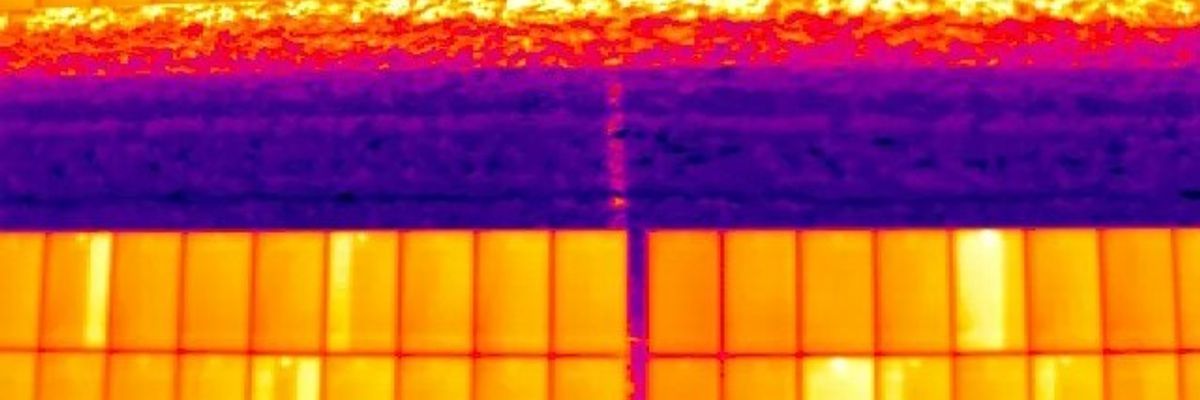
Steady state infrared thermography offers an advanced, non-contact solution for detecting defects in photovoltaic modules. By analyzing temperature distribution under constant illumination conditions, thermal imaging reveals anomalies associated with electrical and structural defects.
Infrared cameras detect temperature differences across the module surface, allowing identification of hotspots, internal short circuits, defective bypass diodes, and areas affected by delamination or moisture ingress. Each defect produces a unique thermal signature, enabling precise diagnosis without physical interference.
This method can be applied during production, commissioning, and regular field inspections, providing continuous and scalable quality control across the entire lifecycle of solar modules.
Benefits
Early detection of defects before significant performance degradation
Non-intrusive, real-time inspection without interrupting system operation
Improved safety through early identification of hotspots and electrical faults
Enhanced module lifespan and reliability through predictive maintenance
Reduced downtime and energy losses with fast and accurate fault localization
The Importance of Early Defect Detection in Solar Modules
The performance and longevity of photovoltaic modules are directly linked to their structural and electrical integrity. Undetected defects introduced during manufacturing or developed during operation can lead to gradual degradation or sudden failure.
Issues such as delamination weaken the internal structure of modules, while moisture ingress can cause corrosion and electrical faults. Cell mismatches reduce efficiency, and microcracks can propagate over time, leading to severe performance losses.
Early detection of these defects is essential for maintaining optimal energy output, reducing maintenance costs, and ensuring long-term system reliability.
Steady State Thermography in Photovoltaic Inspection
Steady state thermography involves capturing thermal images of solar modules under stable illumination conditions, typically at irradiance levels above 700 W/m². Under these conditions, defects manifest as temperature variations due to differences in energy dissipation.
Infrared cameras measure the surface temperature of the module, typically through the front glass, which closely reflects the temperature of the underlying cells. Uniform temperature distribution is expected in properly functioning modules, while anomalies indicate potential defects.
Modules are often analyzed in different operating states, such as open circuit, short circuit, and under load. Each condition reveals different types of issues. For example, hotspots under load conditions may indicate increased resistance or defective bypass diodes.
Accurate measurement requires proper setup, including correct emissivity settings and optimal viewing angles. Minimizing reflections and avoiding airflow across the module surface are also essential to ensure reliable thermal data.
Infrared Imaging for Defect Identification
Infrared thermography enables visualization of defects that are invisible to conventional inspection methods. Thermal anomalies appear as localized temperature increases or irregular patterns across the module surface.
Hotspots are among the most critical indicators, often caused by increased resistance or electrical faults. Larger temperature differences typically indicate more severe defects, while smaller variations may signal early-stage degradation.
High-resolution thermal imaging improves the ability to detect small defects, while sensitive detectors enable identification of subtle temperature differences that would otherwise go unnoticed.
This capability allows operators to not only detect faults but also assess their severity and prioritize maintenance actions accordingly.
Radiometric Thermal Imaging for Accurate Analysis
Radiometric infrared cameras play a key role in advanced defect detection by capturing precise temperature data for every pixel in the image. This enables detailed analysis of temperature distribution and accurate quantification of anomalies.
By comparing temperature differences between affected and unaffected areas, operators can classify defects based on severity. For example, minor temperature deviations may indicate early degradation, while larger differences signal critical issues requiring immediate attention.
This data-driven approach supports predictive maintenance strategies, allowing manufacturers and operators to address problems before they escalate into major failures.
Enhancing Efficiency and Reliability in Solar Energy Systems
Integrating steady state thermography into solar module inspection processes significantly improves overall system efficiency. Rapid, non-intrusive inspection reduces maintenance time and enables large-scale monitoring of photovoltaic installations.
Continuous thermal monitoring helps identify trends and recurring issues, supporting process optimization in manufacturing and improved maintenance strategies in the field.
By reducing defects, preventing failures, and ensuring consistent performance, infrared thermography contributes to lower operational costs and higher energy yield.
Steady state thermography is a powerful tool for non-intrusive defect detection in solar modules. By providing fast, accurate, and comprehensive thermal insights, it enables early identification of defects that could otherwise compromise performance and safety.
With the ability to detect, quantify, and monitor thermal anomalies, infrared imaging supports improved quality control, predictive maintenance, and long-term reliability of photovoltaic systems. As solar energy continues to expand, thermographic inspection will remain essential for ensuring efficient and sustainable power generation.


